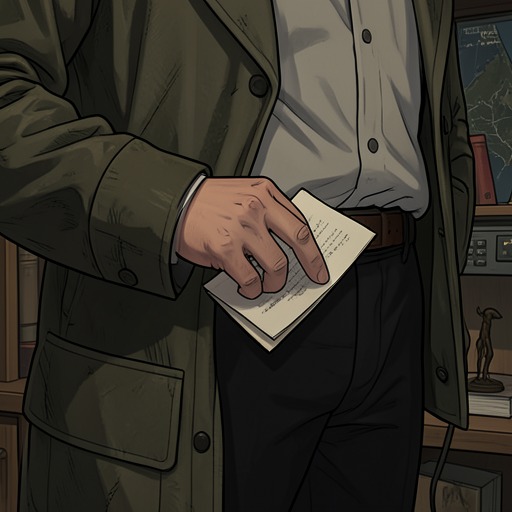
Bathsheba’s Valentine to Boldwood
Far from the Madding CrowdBathsheba’s Valentine to Boldwood is a deliberately misleading message whose consequences far exceed its playful origin. Bathsheba sends it on a whim, but Boldwood reads its “MARRY ME” seal as evidence of a serious invitation to marriage. The letter exposes the gap between an act’s intention and its effect: what is a passing diversion to Bathsheba becomes, for Boldwood, the beginning of an ideal passion and a lasting source of pain.
Composition and dispatch
On St. Valentine’s Day, Bathsheba remembers a valentine she had bought at a stationer’s in Casterbridge. She initially says it is intended for little Teddy Coggan, to whom she has promised a surprise. The card is an ornate, embossed design with a blank oval for a personal message. At Liddy’s suggestion, Bathsheba writes a short verse about a red rose, a blue violet, a sweet carnation, and the recipient. Its childish compliment seems appropriate to Teddy, and Bathsheba encloses the sheet before addressing it.
Liddy then proposes sending the valentine to Boldwood instead, imagining his response. Bathsheba pauses over the idea: Boldwood’s reserve has become noticeable to her, and she is faintly troubled that a respected, wealthy man in the parish does not look toward her as others do. Yet she is not seriously distressed by his indifference. She declines the prank at first, partly because she thinks Boldwood would not appreciate its humor, then changes her mind after a casual choice by tossing a hymn-book. The book falls shut, determining the address in favor of Boldwood. Bathsheba seals the letter with a large red seal whose motto she cannot initially read; when she discovers its message, “MARRY ME,” she finds it amusing and sends the letter that evening.
The card’s making and dispatch are marked by casual decisions rather than a considered proposal. Bathsheba has some knowledge of love as a spectacle, but the episode shows that she does not understand what the gesture will mean to its recipient. In the narrator’s account, the decisive irony lies in the disproportion between the trivial procedure—an idle suggestion, a tossed book, and a seal chosen for its incongruity—and the seriousness Boldwood will attach to the result.
Boldwood’s interpretation
Boldwood receives the valentine the next morning. At supper that evening, he repeatedly looks at it where it rests on the spread-eagle clock above his mantel. He cannot clearly read the seal from where he sits, but imagines its words and sees “MARRY ME.” In the grave quiet of his household, the message takes on a solemnity quite unlike the thoughtlessness with which it was sent. He does not know that its motive was slight and cannot imagine that the sender meant it as a joke.
The letter disturbs a life that the narrative presents as previously ordered and emotionally undisturbed. Boldwood treats its arrival as proof that it must have had a deliberate motive; the possibility that a passing circumstance produced the message does not occur to him. At night he places it by the looking-glass and imagines the unknown woman who wrote it, giving the anonymous hand and its unseen author a presence in his mind. The imagined woman has no distinct identity, even though Bathsheba—the writer—is asleep and unaware of the letter’s effect.
Boldwood later searches the envelope, wondering whether it contains anything beyond the sheet he has already read. He finds nothing, studies the red seal again, and says aloud, “Marry me.” The episode makes the written message less important to him than the fact that someone has sent it: the arrival itself suggests a hidden intention, and his imagination supplies the certainty the letter does not contain. That mistaken certainty is the mechanism by which a brief joke acquires enduring force.
From misunderstanding to proposal
When Boldwood learns that Bathsheba wrote the letter, the anonymous message becomes, in his mind, a personal declaration. Gabriel Oak identifies her handwriting when Boldwood shows him the letter from his pocket-book. Gabriel’s flushed response comes from his own feelings for Bathsheba, but Boldwood misreads his confusion and remains preoccupied with what the valentine signifies. The news confirms the writer’s identity without correcting Boldwood’s mistaken account of her intention.
Boldwood’s feelings intensify as he begins to regard Bathsheba as beautiful and to understand the valentine as an invitation. When he sees her dealing with another farmer, he feels jealousy for the first time and considers intervening, but cannot bring himself to interrupt her business by asking to see a sample of her corn. Bathsheba, meanwhile, recognizes that her prank has secured the attention she had wanted to attract, but values the triumph little because it came about through misdirected ingenuity. She regrets having disturbed a man she respects and considers apologizing, while fearing that he might read an apology either as ridicule or as further encouragement.
Boldwood eventually asks Bathsheba to marry him. He explains that at forty-one he had been a confirmed bachelor, but that seeing her has changed his view of his life; he wants her as his wife and believes the valentine gave him reason to hope. Bathsheba says she respects him but does not love him and cannot accept. When she admits that sending the card was thoughtless and asks forgiveness, Boldwood begs her not to reduce it to a joke: to him, that explanation would make the pain of his hope harder to bear. He asks her not to refuse him absolutely, and she cannot bring herself to give him an immediate final answer, though she does not promise to marry him.
The valentine thus helps produce a proposal grounded in a false premise. Boldwood’s sincerity does not make Bathsheba’s feelings reciprocal, and her pity and respect cannot supply the love he seeks. Her difficulty is sharpened by the recognition that she began the episode and ought, in honesty, to face its consequences; nevertheless, she does not want Boldwood as a husband. The letter leaves her caught between regret for having encouraged his hope and the knowledge that she cannot fulfill it.
Rejection and lasting consequences
The misunderstanding continues after Bathsheba later rejects Boldwood in a letter. When he speaks with her again, he recalls her earlier moments of warmth and treats them, along with the valentine, as evidence that she once turned toward him. Bathsheba insists that she promised him nothing: her kindness at the sheep-washing, at the shearing, and at her home belonged to those occasions and was not a promise of marriage. She describes the Valentine as an idle game and says she has bitterly repented of it.
Boldwood distinguishes between the feeling he took to be a promise and Bathsheba’s account of a passing act. In his view, he first knew nothing of her and was content; after the letter, he hoped for her, and rejection returned him to a different kind of loss. Bathsheba’s explanation cannot undo the meaning he gave the message. The recollection therefore keeps the original act alive in their later conflict: the card is not simply an object from the past but the evidence around which Boldwood organizes his hope and Bathsheba her remorse.
The episode’s central irony is that neither the card’s explicit words nor the sender’s actual intention determines its consequences on its own. Bathsheba chooses a message whose apparent meaning is unmistakable, yet treats it as a joke; Boldwood accepts that meaning as earnest, without knowing how it was made. The valentine’s journey from a Sunday diversion to the basis of a marriage proposal and a painful rejection shows how chance can start a chain of events that neither person can later control.